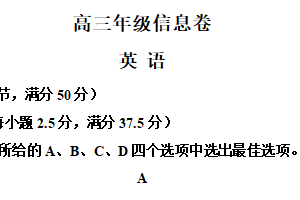

高三年级信息卷
英 语
第二部分 阅读(共两节,满分50分)
第一节(共15小题;每小题2.5分,满分37.5 分)
阅读下列短文,从每题所给的A、B、C、D四个选项中选出最佳选项。
A
Come to China, enjoying four amazing teas
West Lake Longjing
West Lake Longjing is one of China’s famous green teas, produced in Hangzhou, Zhejiang province. It’s renowned for its unique appearance, aroma and taste. With a long history dating from the Tang Dynasty, Longjing tea improved over time, and was offered as a tribute (贡品) in the Qing Dynasty. West Lake Longjing tea is known for its benefits such as refreshing the mind, quenching (缓解) thirst, and reducing fats in the blood.
Enshi Yulu
Enshi Yulu is the only remaining steamed needle-shaped green tea in China, produced in Enshi, Hubei province. The dry tea resembles pine needles and has a lush green color. Its production technique dates back to the Tang Dynasty and gained fame during the Ming and Qing Dynasties. Enshi Yulu has a moderate selenium (硒) content and offers health benefits such as antioxidation and anticancer properties.
Pu’er
Pu’er is a unique fermented (发酵的) tea from Yunnan province classified into two types: raw and ripe Pu’er. It originated in the Tang Dynasty, but it wasn’t until the Qing Dynasty that Pu’er tea became significant trade goods. Raw Pu’er tea is initially bitter but becomes smoother and pleasant with age. Ripe Pu’er tea undergoes artificial fermentation, resulting in a rich flavor with distinctive aged aromas and sweetness.
Jasmine Tea
Typically based on green tea, jasmine tea combines the fragrance of jasmine flowers with tea leaves. It dates back to the Song Dynasty when people began mixing jasmine flowers with tea to enhance the tea’s fragrance. By the Ming and Qing Dynasties, it had became a tribute tea for the imperial court. Jasmine tea is particularly suitable for consumption in hot summers, helping people to cool down.
21. Which type of tea best suits patients with cancer?
A. West Lake Longjing. B. Enshi Yulu. C. Pu’er. D. Jasmine Tea.
22. Pu’er tea has its uniqueness in that __________.
A. it is produced with artificial technology
B. the aging process allows it a rich flavour
C. it was supplied to the emperor as a tribute
D. the fermentation happens in natural states
23. What do the four types of tea have in common?
A. They were available in the Tang Dynasty.
B. They are green teas with different aromas.
C. They are well-known for their medicinal value.
D. They developed over time before rising to fame.
B
It has been five years since I left my staff job and became self-employed. I remember my terror as I walked out of the office for the last time and the excitement when I sold my first piece days later. Working for yourself, setting your own hours and being responsible for your success or failure are exciting. I left my job just as summer was starting, and my first few months were as blissful as the fair days.
When winter came, an office where someone else paid for the heating system and my salary was guaranteed seemed attractive. January is tough for freelancers (自由职业者), and it was no different for me—after masses of work, I earned none. I shared my fears with some businesswomen I knew—what if the reality would be more like what I was experiencing?
Whether through choice or circumstance, the number of freelancers is rising and, if you’re just starting out, it is scary. I’ve been lucky that these women making money their own way shared key lessons about what it takes.
You can’t feel half-hearted about what you do because, at some point, you’re going to have painful days. When that happens, you have to remember why you wanted this life in the first place. Don’t quit your job for something that you think might be more interesting, quit it for something you can’t stop thinking about.
Setting up a business is tough. Rather than waiting until all is perfect, go for the moment when it feels as if momentum (势头) is with you. Look after yourself. There is no sick pay when you are self-employed. You can’t do a bad day’s work and blame it on your boss. You are the backbone of your business and you need to prioritize your health and well-being. Rest regularly and find like-minded people to support you and lift you up when things get hard.
Finally, enjoy it. Freedom is yours and, if you can make it work, there is nothing better.
24. How did the author feel when she was self-employed in paragraph 1?
A. Pleased. B. Challenged. C. Awful. D. Bored.
25. What bothered the author when winter came?
A. Masses of freelance work. B. Failure to meet daily basics.
C. The change in her own taste. D. The unexpected cold weather.
26. According to the author, why should we quit for a new job?
A. To escape from the current pain. B. To satisfy our temporary interests.
C. To pursue what we really desire. D. To explore where our strengths lie.
27. What’s the author’s probable attitude towards becoming freelancers?
A. Unclear. B. Critical. C. Favorable. D. Cautious.
C
If you’re seeking a plain-language intro to statistics, or just want to get better at judging the reliability of numbers in the news, Spiegelhalter’s The Art of Statistics is a solid crash course. The book is less about learning how to use specific mathematical tools than it is about exploring the numerous ways statistics can help solve real-world problems and why warnings are often added to statistical claims.
Spiegelhalter, a statistician at the University of Cambridge, keeps things lively by tying new concepts to questions. For instance, should you worry that eating bacon will increase your risk of bowel (肠) cancer? The relative risk might make you think people who eat a bacon sandwich every day have an 18 percent higher risk of bowel cancer than those who don’t. But looking at the absolute risk—a rise of 6 to 7 cases per 100 people—may put your mind at ease.
Spiegelhalter’s narration is encouraging, and he makes complex sections easier to resolve by including frequent summaries and lots of data visualizations. The Art of Statistics is alive with his enthusiasm for how statistics can be used to collect information for court cases, city planning and a host of other sectors.
But Spiegelhalter warns readers not to forget the assumptions and uncertainties in any analysis and tells many cautionary tales about the ways statistics can go off the track. For example, incomplete samples and logical missteps can lead to faulty conclusions.
Spiegelhalter doesn’t let the media off the hook, either. Many of the questions he uses to introduce topics are drawn from misleading news reports. Such articles include one claiming that going to college increases your risk of getting a brain tumor (瘤), which mistook correlation for causation in data on socioeconomic status and tumor diagnoses.
The Art of Statistics leaves readers with a better handle on the ins and outs of statistical analysis. As Spiegelhalter writes, “Numbers may appear to be cold, hard facts, but… they need to be treated with delicacy.”
28. What’s special about The Art of Statistics?
A. It offers a reliable course in statistics. B. It focuses on reasonable data analyses.
C. It warns the public of statistical claims. D. It includes effective tools for math learners.
29. What’s the purpose in mentioning the example in paragraph 2?
A. To compare two dramatically different lifestyles.
B. To stress the importance of having a healthy diet.
C. To show an effective way to explain new concepts.
D To relieve public concern over unreliable numbers.
30. What do the underlined words “off the hook” mean in paragraph 5?
A. Free from blame. B. Familiar to all. C. In good condition. D. Out of control.